Most law firm newsletters read like hostage notes—forced, uncomfortable, and written by someone who clearly doesn’t want to be there. After reviewing hundreds of these painful attempts at “client engagement,” I can tell you the problem isn’t the medium. It’s that attorneys treat newsletters as an obligation rather than an opportunity to demonstrate expertise in ways that actually matter to clients.
The firms that generate consistent referrals and repeat business from newsletters understand something others miss: your newsletter isn’t about your firm. It’s about solving problems your clients don’t yet know they have.
Why Do Small Law Firms Need a Newsletter?
The economics are straightforward. Acquiring a new client costs significantly more than retaining an existing one or generating a referral. Your newsletter creates touchpoints with people who already trust you—former clients, referral sources, professional contacts. These warm connections convert at higher rates than cold marketing.
Beyond direct ROI, newsletters serve strategic purposes that other marketing channels can’t match:
- Maintaining top-of-mind awareness without being intrusive
- Educating clients about legal issues before they become emergencies
- Demonstrating ongoing expertise and practice evolution
- Creating referral opportunities through forwarded content
The attorneys who dismiss newsletters as outdated usually haven’t seen them done correctly. They’re comparing spam-style firm updates to strategic communication tools that drive real business outcomes.

What Makes a Law Firm Newsletter Worth Reading?
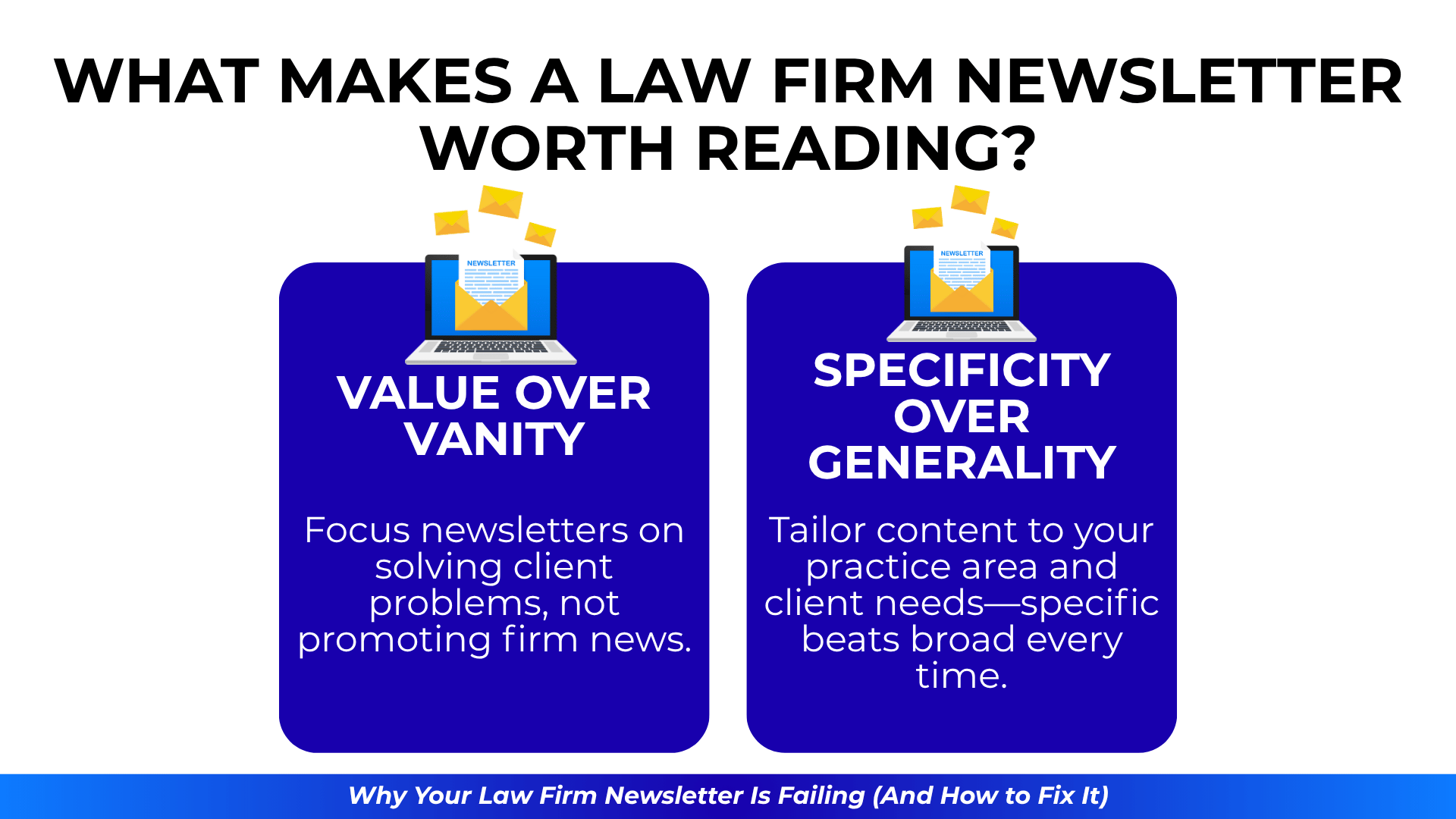
Value Over Vanity
Nobody cares that you attended a CLE or added a new associate—unless it directly benefits them. Yet most law firm newsletters lead with firm news, award announcements, and partner profiles. This narcissistic approach guarantees low engagement.
Valuable newsletters answer questions clients actually have:
- How new legislation affects their business or family
- Common legal mistakes in their industry or situation
- Practical guidance for navigating legal challenges
- Warning signs that require legal intervention
Specificity Over Generality
Generic legal updates fail because they compete with thousands of similar newsletters. The criminal defense attorney who writes about “recent Supreme Court decisions” loses to the one explaining “what the new expungement law means for your record.”
Practice area focus matters. Estate planning clients need different content than personal injury victims. Trying to serve everyone with one newsletter serves no one effectively.
How Often Should You Send Your Law Firm Newsletter?
The Frequency Formula
Monthly newsletters work for most small firms. This frequency maintains presence without overwhelming recipients or creating unsustainable content demands. Weekly is too aggressive unless you’re publishing genuinely newsworthy content. Quarterly is too sparse to maintain meaningful connection.
The exception: time-sensitive practice areas. Immigration firms during policy changes or tax attorneys during filing season might justify increased frequency. But only if every issue delivers specific, actionable value.
Consistency Matters More Than Frequency
Sending monthly for three months then disappearing for six is worse than sending quarterly consistently. Irregular publication trains recipients to ignore your emails since they can’t predict value.
Choose a sustainable schedule and maintain it. Better to start quarterly and increase frequency than to start weekly and flame out.

What Content Actually Drives Engagement?
The 80/20 Content Rule
Effective newsletters follow roughly this distribution:
- 80% educational content solving client problems
- 20% firm-related updates and calls to action
This ratio provides value while still advancing business objectives. Pure education without any firm connection wastes opportunity. Pure promotion without value guarantees unsubscribes.
Content Types That Work
Case Studies (Anonymized): Real situations demonstrate expertise better than abstract legal theory. “How we helped a client reduce their DUI charge” resonates more than “Understanding DUI law.”
Practical Checklists: Give readers actionable tools. “5 documents to gather before meeting your divorce attorney” provides immediate value while positioning you as the logical choice when they’re ready.
Legal Myth-Busting: Address misconceptions in your practice area. “Why you can’t just write your will on a napkin” educates while highlighting the value of professional services.
Timely Analysis: Connect current events to legal implications. But avoid pure political commentary—focus on practical legal impacts.

Common Law Firm Newsletter Mistakes to Avoid
Writing for Lawyers Instead of Clients
Your audience doesn’t need citations or exhaustive legal analysis. They need to understand how law affects their life or business. Write at an accessible level without condescending. Explain technical terms when necessary.
Ignoring Mobile Optimization
Most professionals read email on phones. Dense paragraphs, tiny fonts, and desktop-only designs guarantee your carefully crafted content goes unread. Design for mobile first.
Buying Subscriber Lists
Purchased email lists seem like a shortcut to growth. They’re actually a shortcut to spam folders and reputation damage. Build your list organically through website opt-ins, client permissions, and networking contacts.
Neglecting Segmentation
Sending identical content to divorce clients and business litigation clients wastes opportunity. Even basic segmentation—practice area, client vs. referral source, geographic location—dramatically improves relevance and engagement.

How Can AI and Automation Improve Your Newsletter?
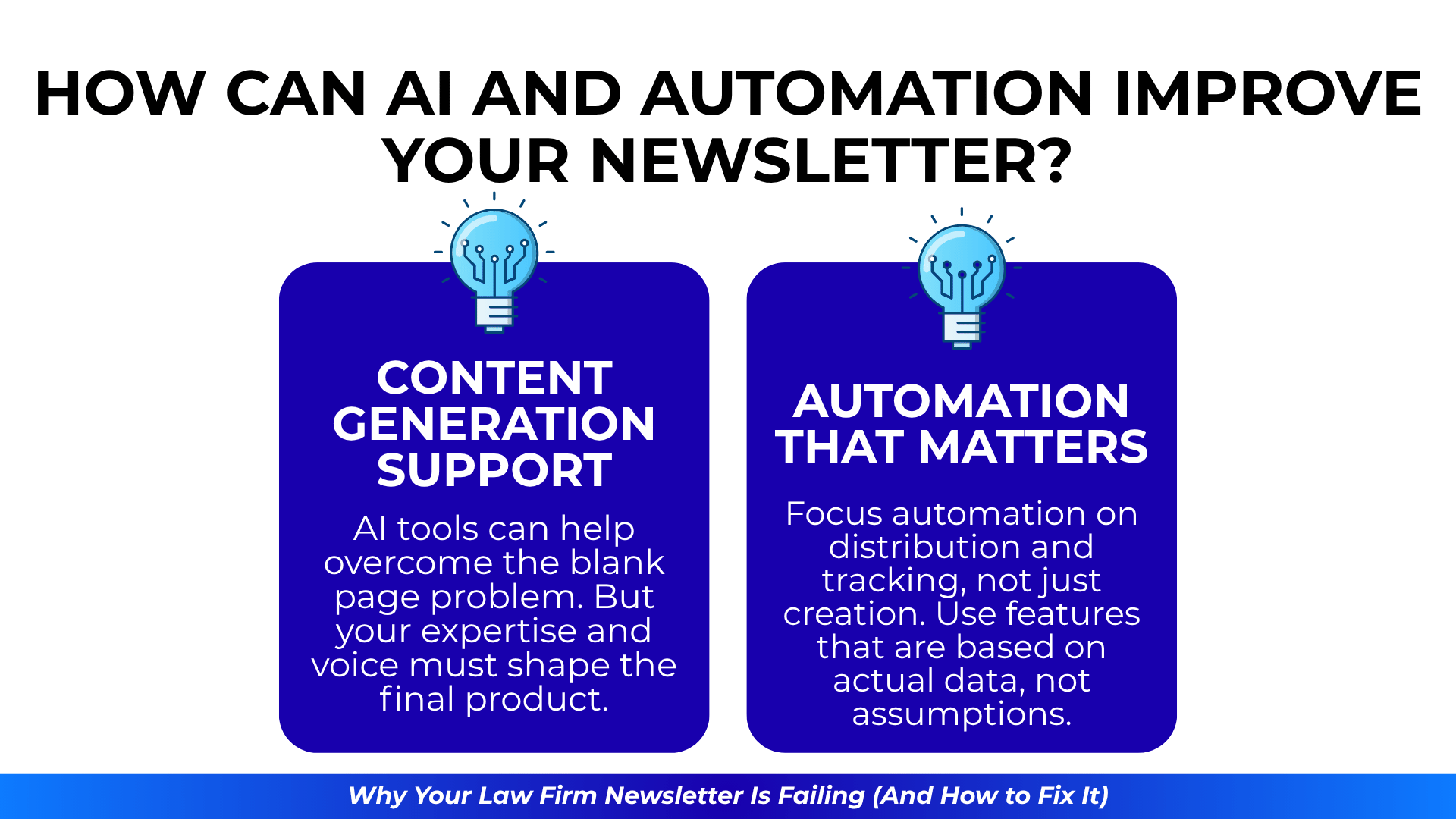
Content Generation Support
AI tools can help overcome the blank page problem. Use them to:
- Generate initial drafts from bullet points
- Summarize complex legal developments
- Create multiple headline options
- Suggest relevant topics based on practice area
But don’t publish AI output directly. These tools create starting points, not finished content. Your expertise and voice must shape the final product.
Automation That Matters
Focus automation on distribution and tracking, not just creation:
- Automated welcome series for new subscribers
- Behavior-triggered follow-ups based on engagement
- A/B testing subject lines and send times
- Performance tracking and reporting
Many email platforms now include AI-powered send time optimization and subject line testing. Use these features—they’re based on actual data, not assumptions.
Building Your Law Firm Newsletter Strategy
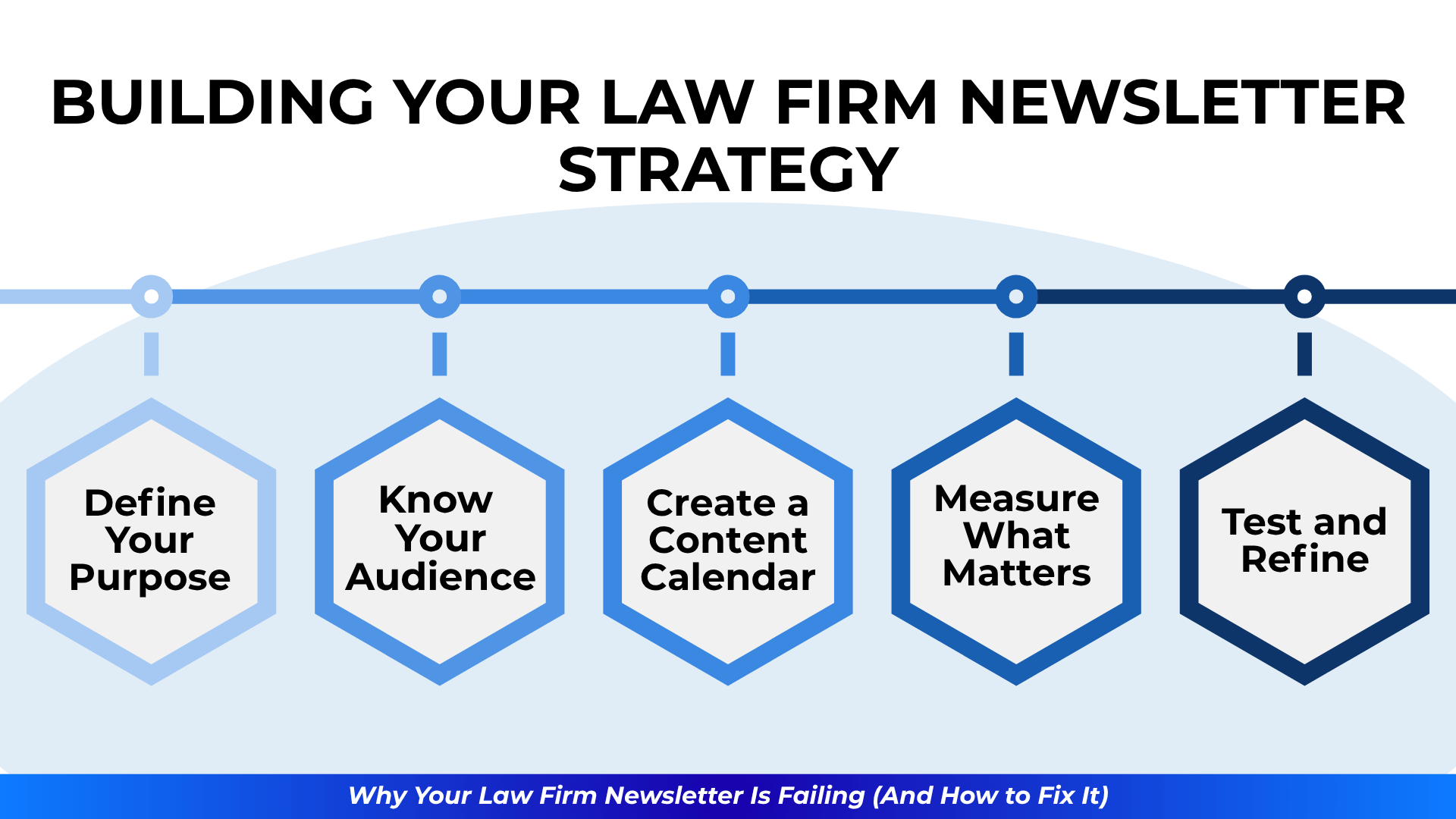
Start with these fundamentals:
- Define Your Purpose: Lead generation? Client retention? Referral development? Different goals require different approaches.
- Know Your Audience: Current clients have different needs than potential clients. Referral sources need different content than end users.
- Create a Content Calendar: Plan topics quarterly but write monthly. This balances strategy with flexibility for timely content.
- Measure What Matters: Open rates indicate subject line effectiveness. Click rates show content relevance. Replies and referrals demonstrate business impact.
- Test and Refine: Every newsletter teaches you something about your audience. Use data to improve continuously.
The Bottom Line on Law Firm Newsletters
A well-executed law firm newsletter remains one of the highest-ROI marketing activities for small firms. The key is treating it as a strategic tool rather than a checkbox exercise. Focus on delivering consistent value to a specific audience, and business development follows naturally.
The firms that succeed with newsletters aren’t necessarily better writers or marketers. They simply commit to serving their audience consistently with relevant, valuable content.
If you want help developing a newsletter strategy that actually drives business—from content planning to automation setup—let’s discuss your specific practice and goals. I’ve helped enough firms transform their newsletters from ignored obligations into business development engines to know what works.